

This determination to never give up despite heaving obstacles has been the constant theme of Radhanath Swami’s life. Focusing on the negative side of things weakens that determination, and so Radhanath Swami never sees the negative, he is always positive.
Read More Post a comment (80)
Once a mystic named Bisakisena, who could produce fire from his head lived in the state of Orissa and engaged in many immoral practises. Bisakisena also declared he’d drive off the British from ruling Orissa and would himself become the king of India.
Read More Post a comment (58)
Radhanath Swami also defines simplicity as the simple acceptance of the Lord’s order without unnecessarily complicating matters. Doubts on the instructions of God comes from a duplicitous mind
Read More Post a comment (80)
Radhanath Swami often compares the internal struggle of a spiritualist to the cleansing of a room. When we begin cleaning a room that has been dirty for years, a lot of dust starts rising in the room. We may cough and find it very uncomfortable initially but the need is to continue the cleaning despite the inconveniences.
Read More Post a comment (60)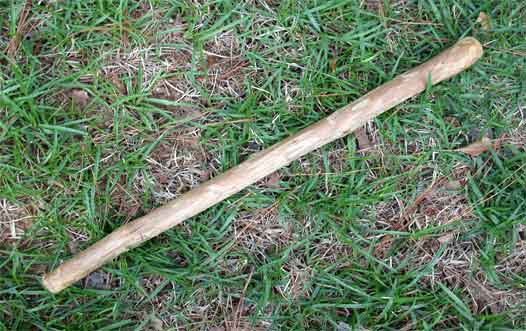
While leaving Rama Sevaka Swami’s ashram, Richard (now Radhanath Swami) received a gift from Rama Sevaka Swami- his own personal walking stick. Narayana Prasad translated Rama Sevaka Swami’s words, “the stick of a devotee’s mercy can save one from the greatest dangers.”
Read More Post a comment (45)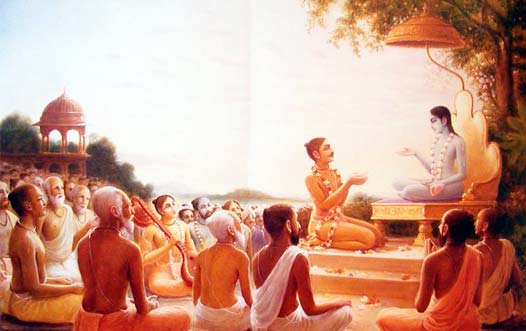
At Rama Sevaka Swami’s ashram, Richard (now Radhanath Swami) heard Ramayana, the story of Lord Rama and saw all the assembled sadhus exhibit various emotions. Sometimes during the narration they laughed, at other times they cried in sorrow or even sat motionless in suspense. Since the language was foreign to Richard, he wondered if he could hear the translation.
Read More Post a comment (31)
“A dog will recognize his master in whatever way he dresses. The master may dress in robes, suit and tie, or stand naked, but the dog will always recognize his master. If we cannot recognize God, our beloved master, when he comes in a different dress from another religion, then we are less than that dog.”
Read More Post a comment (30)
Richard (now Radhanath Swami) now arrived at Patna and got the association of Narayan Prasad and his guru Rama Sevaka Swami. Simplicity and devotion poured from the heart of Rama Sevaka Swami in whatever he did. For hours daily he chanted the Holy Names of Lord Rama and he personally fed Richard with his own hands. While staying with him, one day a sadhu, visiting monk, cooked kichari for all. It was unbearably spicy and caused lot of suffering to Richard while the others were enjoying it.
Read More Post a comment (36)
Richard (now Radhanath Swami) got trapped in a quick sand and as he was drowning, a boat man waved his hand and indicated that he swim forward with the current of Yamuna. There once again he heard the Hare Krishna Maha Mantra, the song he had first heard from Mother Ganges at Rishikesh. He finally survived and sat on the river bank. Earlier he had found the sand to be scorching but now the sand was cool and soft. He reflected on how humans are also like this sand. A person influenced by his association or circumstances can either become envious or affectionate. Our company has an effect on our consciousness. Therefore we have to be instruments of kindness by associating with the inherent goodness of all rather than the negativities.
Read More Post a comment (59)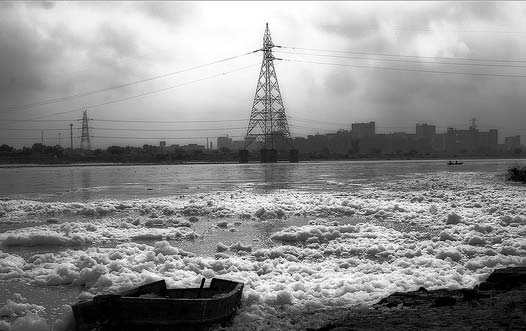
Radhanath Swami Fan Blog – Need for absorption in spiritual life
Radhanath Swami says we have to go deeper in our spiritual lives by connecting to God in the innermost chambers of our heart. He compares the heart to a palace with many rooms. In the centre of this palace of the heart there are private chambers. It is in these regions of the heart- the deep internal recesses- we keep our private life with separate desires. Our challenge therefore as spiritualists is to allow God to enter these chambers or give these chambers to God and allow him to access.
Read More Post a comment (54) Table of Contents
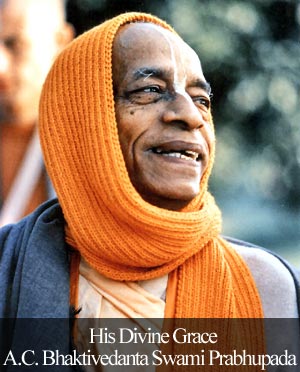 Founder-acharya of the International Society For Krishna Consciousness (ISKCON)
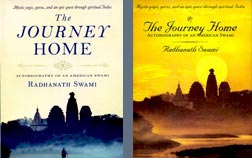
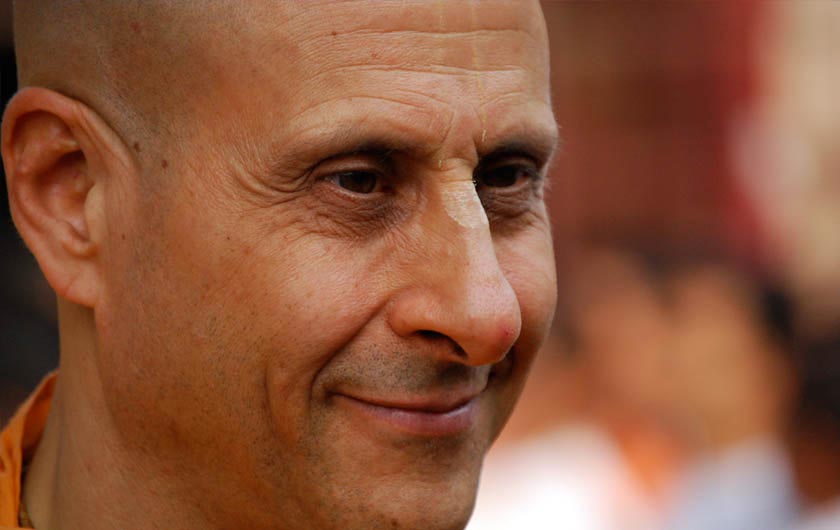 “Go to India” a sweet but commanding voice; spoke up in the heart of young Richard (later Radhanath Swami) who was immersed in meditation, his search for meaning in life has brought him to the Isle of Crete. Today he was ordered to go to India. Born and raised in the middle class suburbs of Chicago, Radhanath swami grew up in the 1950’s and 60’s era when popular musicians protested war, prejudice and social injustice. Radhanath swami would listen to these songs again and again, but their lyrics referring to God stirred his soul. Peter, Paul and Mary- the folk trio from Greenswich village sang in their debut album
“Early in the morning, about the break of day
I ask the Lord, to help me find my way”
This simple prayer was to guide Radhanath swami in the coming years of his life........
“Go to India” a sweet but commanding voice; spoke up in the heart of young Richard (later Radhanath Swami) who was immersed in meditation, his search for meaning in life has brought him to the Isle of Crete. Today he was ordered to go to India. Born and raised in the middle class suburbs of Chicago, Radhanath swami grew up in the 1950’s and 60’s era when popular musicians protested war, prejudice and social injustice. Radhanath swami would listen to these songs again and again, but their lyrics referring to God stirred his soul. Peter, Paul and Mary- the folk trio from Greenswich village sang in their debut album
“Early in the morning, about the break of day
I ask the Lord, to help me find my way”
This simple prayer was to guide Radhanath swami in the coming years of his life........